
Patience in Trading: The Difference Between Making Money and Building Wealth
Patience in trading is one of the most overlooked skills in the financial markets. While traders spend countless hours searching for better indicators, strategies, and entry signals, many overlook the one characteristic that often determines long-term success: the ability to remain patient when emotions are telling you to act.
A trader turns $10,000 into $18,000 in six months.
Confidence grows. Every trade feels like an opportunity. Position sizes increase. Rules become optional. Risk management takes a back seat.
Then the market changes.
A few losses turn into frustration. Frustration turns into impulsive decisions. Within months, the account falls below its original value.
The market didn’t beat the trader.
Impatience did.
This story plays out every day in financial markets. Most traders focus on making money. The traders who build lasting wealth focus on something different: preserving capital, managing emotions, and allowing time to work in their favor.
Why Patience in Trading Matters
Financial markets reward discipline, but human psychology is wired for instant gratification.
We want results now. We want confirmation now. We want profits now.
Unfortunately, markets rarely reward this mindset.
The most successful traders understand that profits are often the byproduct of patience. They know that forcing trades, chasing opportunities, and reacting emotionally usually leads to poorer outcomes.
As Warren Buffett famously said:
“The stock market is a device for transferring money from the impatient to the patient.”
Although Buffett was referring primarily to investing, the principle applies equally to trading. Markets constantly test emotional discipline. The ability to remain patient while others become emotional is often a significant competitive advantage.
The Wake-Up Call That Changed My Trading
There is one message I will never forget seeing on my phone.
It wasn’t a market alert,
It wasn’t a winning trade.
It was a liquidation notice.
I woke up in the middle of the night, reached for my phone, and saw the message:
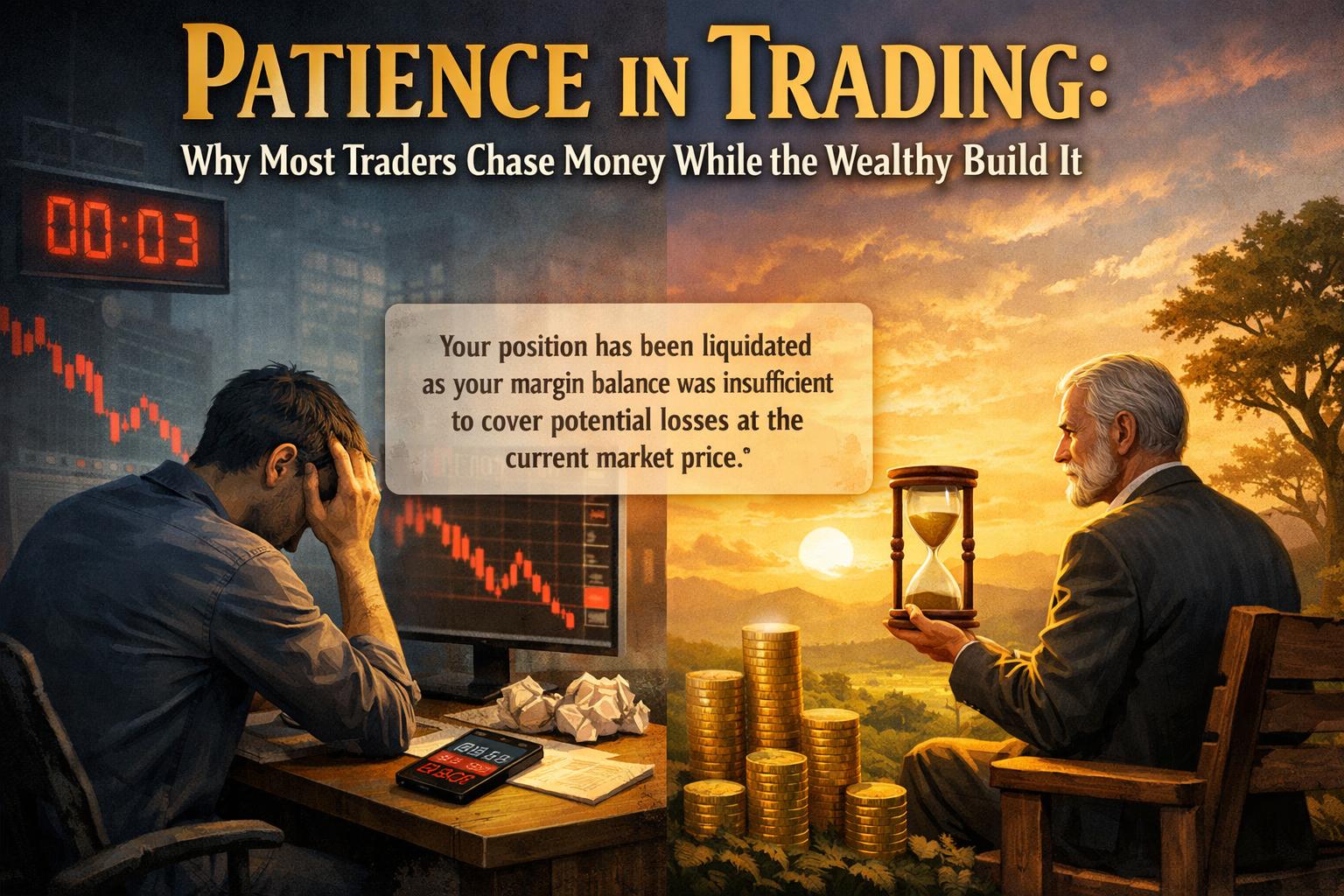
“Your position has been liquidated as your margin balance was insufficient to cover potential losses at the current market price.”
For a few seconds, I just stared at the screen.
If you’ve ever received a message like that, you know the feeling.
Your stomach drops.
Your mind immediately starts replaying every decision that led to that moment.
The position seemed reasonable when I entered it. The market looked like it would move in my favor. I convinced myself the risk was acceptable.
But looking back, the liquidation wasn’t caused by a single bad trade.
It was caused by impatience.
Impatience to grow the account faster.
Impatience to recover previous losses.
Impatience to force opportunities instead of waiting for them.
That notification was expensive, but it taught me a lesson that no book, course, or YouTube video could have taught me.
The market does not care how badly you want a trade to work.
The market rewards discipline, not desire.
From that point forward, I stopped measuring success by how many trades I took or how quickly I could grow an account.
Instead, I started focusing on protecting capital, managing risk, and waiting for opportunities that genuinely matched my rules.
Ironically, once I became more patient, my results improved.
The biggest shift wasn’t in my strategy.
The biggest shift was in my mindset.
That liquidation notice felt like failure at the time.
Today, I see it as one of the most valuable lessons I ever received.
The Difference Between Making Money and Building Wealth
Many traders mistakenly believe that making money and building wealth are the same thing.
They are not.
Making money is a short-term outcome.
Building wealth is a long-term process.
A trader can have an excellent month and still fail financially over the next five years. Likewise, a trader can experience modest gains while steadily creating substantial wealth through consistency and disciplined execution.
Consider two traders.
Trader A: The Profit Chaser
Trader A is always active.
They check charts constantly, chase breakouts, and feel uncomfortable when they are not in a trade.
Characteristics include:
- Frequent trading
- Emotional decision-making
- Larger position sizes after wins
- Constant strategy changes
- Focus on short-term results
Trader B: The Wealth Builder
Trader B understands that opportunities will always exist.
Their objective is not maximum activity. It is maximum consistency.
Characteristics include:
- Strict trading rules
- Controlled risk management
- High-probability trade selection
- Long-term performance tracking
- Capital preservation during difficult periods
Trader A may experience rapid gains.
Trader B is significantly more likely to build lasting wealth.
The difference is often patience.
How Impatience Destroys Trading Performance
The majority of trading mistakes are not caused by a lack of technical knowledge.
They are caused by emotional decision-making.
Overtrading
Many traders assume more trades create more opportunities.
In reality, more trades often create more mistakes.
Patient traders understand that quality matters more than quantity.
Revenge Trading
A losing trade can create a powerful urge to recover losses immediately.
This emotional reaction often leads to even larger losses.
Fear of Missing Out (FOMO)
Watching a market move without you can feel frustrating.
However, chasing trades after the optimal entry has passed often increases risk while reducing potential reward.
Constant Strategy Switching
Every strategy experiences periods of underperformance.
Many traders abandon profitable systems before they have enough data to evaluate them properly.
Patience allows an edge to play out over time.
The Connection Between Patience and Risk Management
Patience and risk management are closely connected.
Patient traders tend to take fewer trades, which naturally reduces unnecessary risk exposure.
More importantly, patient traders are often better at preserving capital during difficult market conditions.
If you want to improve long-term performance, understanding sound risk management principles is essential.
Risk Management for Automated Trading
Similarly, protecting your account during losing periods is critical for long-term growth.
Trading Drawdown Protection and Compounding
Why Compounding Rewards Patient Traders
One of the greatest benefits of patience in trading is the ability to harness compounding.
Small, consistent gains accumulated over years can produce extraordinary results.
Many traders interrupt this process by taking excessive risks, abandoning strategies prematurely, or attempting to accelerate results.
The reality is simple:
Compounding rewards consistency.
Consistency requires patience.
If you’re interested in avoiding common mistakes that prevent compounding from working effectively, see:
Top 10 Mistakes Traders Make With Compounding
Four Practical Ways to Develop Patience in Trading
Patience is not something traders are born with.
It is a skill that can be developed.
1. Create a Trading Plan
Define entry criteria, exit criteria, position sizing rules, and maximum risk before entering a trade.
2. Maintain a Trading Journal
Track:
- Why you entered
- Why you exited
- Risk taken
- Emotional state
- Outcome
Patterns become much easier to identify when documented consistently.
3. Focus on Process Rather Than Outcomes
A good trade can lose money.
A bad trade can make money.
Judge yourself based on whether you followed your process.
4. Think in Months and Years
Most professional traders evaluate performance over large sample sizes.
Individual trades matter far less than long-term consistency.
What Research Says About Investor Behavior
Research in behavioral finance has repeatedly shown that emotional decision-making can negatively impact investment and trading performance.
Many investors buy after markets have already risen significantly and sell after substantial declines, effectively doing the opposite of what long-term success requires.
Further reading:
- Investopedia: Trading Psychology
- Investopedia: The Power of Compounding
- FINRA Investor Education Resources
Understanding these behavioral tendencies can help traders recognize emotional patterns before they become costly mistakes.
The Real Competitive Advantage
Many traders spend years searching for:
- Better indicators
- Better software
- Better signals
- Better strategies
Yet one of the most powerful advantages requires none of these things.
Patience.
Patience helps traders wait for quality opportunities.
Patience protects capital.
Patience reduces emotional decision-making.
Patience allows compounding to work.
Most importantly, patience enables traders to think differently from the crowd.
While others chase excitement, patient traders focus on execution.
While others react emotionally, patient traders follow their process.
While others seek quick profits, patient traders build wealth.
Final Thoughts
Patience in trading is not passive.
It is a skill.
It is a discipline.
And for many traders, it is the missing link between temporary profits and lasting wealth.
Markets will always provide opportunities.
The challenge is having the patience to wait for the right ones.
The traders who achieve long-term success are rarely the ones making the most trades.
More often, they are the ones making the best decisions consistently over time.
Frequently Asked Questions
Patience in trading means waiting for high-probability opportunities and following a trading plan rather than making decisions based on emotions, fear, or greed.
Patience helps traders avoid overtrading, emotional mistakes, unnecessary risk, and poor trade selection, leading to more consistent long-term performance.
Yes. Patient traders often take fewer but higher-quality trades, which can improve overall profitability while reducing avoidable losses.
Financial freedom means your expenses are covered without relying on a paycheck or constant trading. It’s the ability to live without financial anxiety, supported by assets and systems that generate income in the background.
Studies show that 40% of day traders quit within a month, and only 7% remain after five years. The main reasons are impatience, emotional trading, poor risk management, and chasing hype instead of building systems.
Traders can develop patience through structured trading plans, journaling, risk management, performance reviews, and focusing on long-term outcomes instead of short-term results.
Disclaimer: This content is for educational and informational purposes only. It is not financial advice. Always do your own research and make investment decisions based on your own circumstances.