
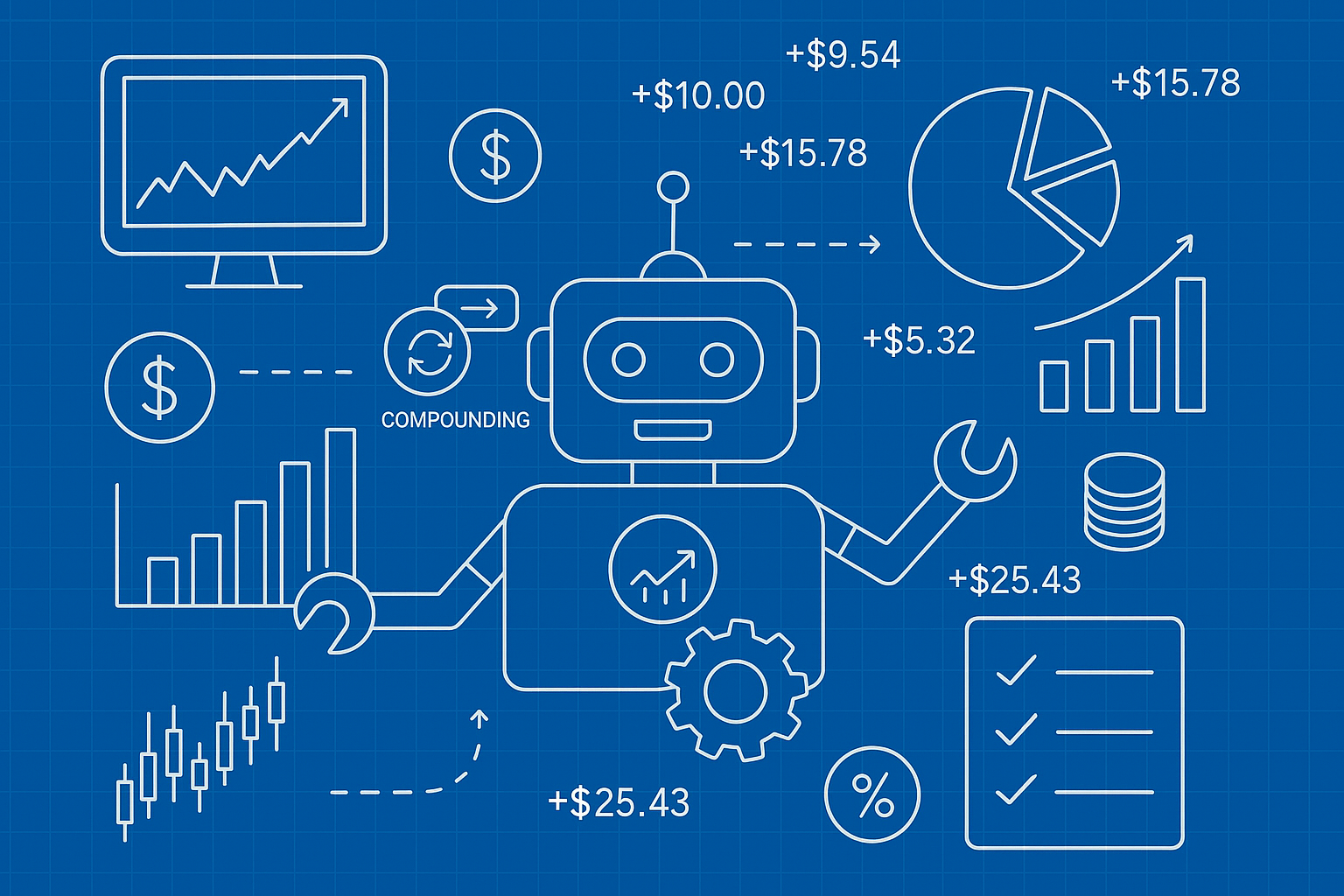
Automated trading bots have exploded in popularity over the last few years. From crypto trading to forex and stocks, traders everywhere are looking for ways to automate strategies and potentially generate consistent profits.
But can trading bots actually make money? And what does it actually take to build a consistently profitable automated strategy? Those are worth exploring honestly — because the gap between social media hype and trading reality is significant.
The answer is yes… but there’s a major catch.
Successful trading bots are usually built on:
- proven strategies
- disciplined risk management
- proper backtesting
- realistic expectations
While social media often promotes “easy passive income,” professional traders understand that long-term profitability comes from consistency and managing risk — not gambling on hype.
In this guide, we’ll break down:
- how trading bots work
- whether they are profitable
- realistic income expectations
- common mistakes traders make
- what separates successful bots from failed ones
A note on this post: This is an educational overview of how automated trading bots work, what affects their performance, and what traders commonly get wrong. It does not contain income projections, targets, or recommendations to trade any specific asset or strategy. Trading involves significant risk. Do your own research and make decisions based on your own circumstances.
What Are Automated Trading Bots?
Automated trading bots are software systems that execute trades based on predefined rules and conditions. Instead of manually watching the market, traders can automate decisions such as:
- Entering trades
- Closing positions
- Managing stop losses
- Taking profits
- Sending alerts
- Adjusting risk exposure
Trading bots are commonly used in:
- Cryptocurrency trading
- Forex trading
- Stock markets
- Futures and derivatives markets
Many professional traders use automation because bots can react faster, remove emotional decision-making, and operate 24/7.
According to Investopedia, algorithmic trading has become a major component of modern financial markets due to its speed and efficiency.
Can Trading Bots Really Make Money?
Yes — trading bots can absolutely be profitable.
However, profitability depends entirely on:
- strategy quality
- market conditions
- risk management
- position sizing
- drawdown protection
- long-term consistency
A trading bot is simply a tool. A bad strategy automated is still a bad strategy.
One of the biggest misconceptions is that profitable bots are “set and forget.” In reality, successful automated traders constantly:
- monitor performance
- optimize strategies
- review analytics
- adapt to changing markets
At AlgoColony, the focus is on building customizable rule-based trading systems rather than selling unrealistic “guaranteed profit” bots.
Which Trading Bot Is the Best in South Africa?
There is no single “best” trading bot for South African traders because different bots are designed for different markets and trading styles.
The best trading bot usually depends on:
- your experience level
- the exchange or broker you use
- your risk tolerance
- the strategy you want to automate
Some traders prefer:
- crypto grid bots
- trend-following bots
- arbitrage systems
- forex expert advisors
- fully customizable rule-based bots
South African traders often use platforms connected to:
- Binance
- VALR
- Bybit
- MetaTrader
- TradingView integrations
- Pepperstone
The real question should not be:
“Which bot makes the most money?”
Instead ask:
“Which bot gives me the best risk-adjusted consistency?”
A sustainable strategy with controlled drawdowns will usually outperform high-risk systems chasing unrealistic returns.
Related:
- trading drawdown protection
- backtesting trading strategies
- Top 5 Algo Trading Strategies for Side Hustlers
AlgoColony is built with this in mind — enabling South Africans to automate trading confidently, with control, not gambling.
Can Trading Bots Make You a Millionaire?
Technically, yes — but it is extremely rare.
Most traders who become highly successful through automation do not achieve it overnight. They typically:
- spend years refining strategies
- manage risk carefully
- compound profits gradually
- survive losing periods
- continuously adapt
The idea of turning a small account into millions quickly is usually associated with:
- excessive leverage
- gambling behavior
- unsustainable risk
Professional traders often focus more on:
- consistency
- preserving capital
- long-term compounding
- statistical edge
Some traders and institutions do build significant wealth through systematic trading over long periods. However, this typically involves years of strategy refinement, strict risk management, surviving losing periods, and compounding gradually — not a single bot running without oversight. The outlier success stories are real but not representative of typical outcomes.
What Is the 3-5-7 Rule in Stocks?
The “3-5-7 rule” is a popular risk management guideline used by some traders.
It generally means:
- Risk no more than 3% on a single trade
- Keep total exposure under 5%
- Aim for a 7% or greater return target over time
The exact interpretation varies depending on the trader or strategy.
The important takeaway is not the numbers themselves — it’s the concept of controlled risk management.
Most profitable trading systems prioritize:
- preserving capital
- limiting drawdowns
- surviving losing streaks
Many trading bots fail because traders ignore risk management entirely and focus only on profits.
This same type of risk structure can be applied successfully to crypto and FX bot trading as well.
Also have a look at The Top 10 Rules for Successful Investing at investopedia.com
Can Trading Bots Generate Consistent Returns?
This is one of the most searched questions in trading — and it deserves an honest answer rather than a number.
Some traders do generate consistent returns from automated strategies. Others lose money. The difference rarely comes down to which bot they used — it almost always comes down to strategy quality, risk management, and realistic expectations.
A few things worth understanding:
- Returns vary enormously depending on market conditions, strategy type, capital size, and how risk is managed. There is no “standard” return for a trading bot.
- Position sizing matters more than most beginners expect. Oversized positions amplify both gains and losses — many accounts are wiped not by bad strategies, but by poor sizing.
- Compounding works both ways. Consistent small gains compound over time, but so do consistent small losses. The direction depends entirely on whether the underlying strategy has a genuine edge.
- Income targets can be dangerous framing. When traders focus on hitting a daily dollar figure rather than executing their strategy correctly, they tend to take larger risks to “make up” shortfalls — which is how discipline breaks down.
The traders who tend to do well over time focus on process: does the strategy have a tested edge, are losses controlled, and is the approach sustainable? The income, if it comes, follows from that — not the other way around.
This is a general observation about trading behavior, not a forecast of what any individual trader can expect to earn.
Paper Trading: The Smart Way to Validate Strategy Performance
Backtesting is great — but it only tells you what used to work.
AlgoColony also offers:
✔ Live market paper trading
✔ Local tracking of real-time trades
✔ Zero financial risk while learning
You get to see:
- How your strategy behaves in current volatility
- Whether alerts and conditions trigger properly
- If execution aligns with market movement
Trading confidence comes from proof, not hope.
What Is the Best Strategy for Trading Bots?
The most successful strategies combine:
🔑 Trend Confirmation
Trade with the market — not against it.
(Momentum, MACD, EMA crossovers, etc.)
🎯 Risk Management
Define max loss + set take-profit targets
before the trade even starts.
🚫 Fewer Trades, Better Trades
Avoid forcing entries.
Wait until the market is ripe for picking.
🧪 Test → Improve → Validate
Backtest → Paper trade → Go live carefully
Only after the strategy has been tested across different market conditions — keeping in mind that past performance in backtests doesn’t guarantee live results.
Why Most Trading Bots Fail
Most trading bots fail because traders:
- over-leverage
- chase unrealistic profits
- skip backtesting
- ignore drawdowns
- use poor strategies
Common mistakes include:
Over-Optimized Backtests
Some bots look amazing historically but collapse in live markets.
No Stop Losses
A single bad market move can destroy an account.
Emotional Interference
Many traders disable bots after temporary losses, ruining long-term strategy performance.
Poor Market Conditions
Some strategies only work in trending markets or high volatility.
Lack of Patience
Sustainable trading is usually slower and more disciplined than social media suggests.
Backtesting vs Live Trading
Backtesting is essential before risking real money.
A proper backtest should analyze:
- win rate
- drawdown
- profit factor
- market conditions
- long-term consistency
However, live trading introduces:
- slippage
- fees
- latency
- liquidity problems
- emotional pressure
This is why experienced traders focus on probabilities rather than guaranteed profits.
Good automated Trading Bots vs Bad automated Trading Bots
| Feature | Good Trading Bot | Bad Trading Bot |
|---|---|---|
| Risk Management | Strong controls | No controls |
| Backtesting | Extensive | Minimal |
| Drawdown Protection | Yes | Ignored |
| Strategy Logic | Rule-based | Random signals |
| Long-Term Focus | Sustainable | “Get rich quick” |
| Market Adaptation | Optimized regularly | Static forever |
Automation Is Your Edge — But Only With Smart Rules
Trading bots won’t magically make anyone rich — but they can:
- Reduce stress
- Improve discipline
- Execute consistently
- Scale profitable systems
Start small.
Prove your edge.
Let compounding take you further than emotions ever could.
👉 And with AlgoColony, you can setup your own Automated trading bots, design your own strategy, backtest, paper trade it live, and go fully automated once you are ready.
Also, have a look at the article on “Financial Mistakes That Keep You From Building Wealth“.
Yes, profitable trading bots exist, but success depends heavily on strategy quality and risk management.
They can be, especially in volatile markets, but they also carry significant risk.
Yes. Many professional traders and institutions use automation extensively.
Not always. Simple rule-based systems are often more stable and easier to maintain.
Yes, but beginners should first understand trading fundamentals and risk management.
Risks & Trade-Offs
Disclaimer: This content is for educational and informational purposes only. It is not financial advice. Always do your own research and make investment decisions based on your own circumstances.
Over-optimization
Backtests can look perfect but fail in live markets.
Market volatility
Bots can amplify losses if risk controls aren’t set.
Scams
Many bots promise guaranteed profits or “magic” strategies with no explanation. Avoid any provider that asks you to deposit money into a system you don’t control or understand. Legitimate platforms allow you to see and customize the rules, test with paper trading, and manage your own API keys. Never give money to a provider that doesn’t show you how the strategy works — transparency is key to avoiding fraud.