
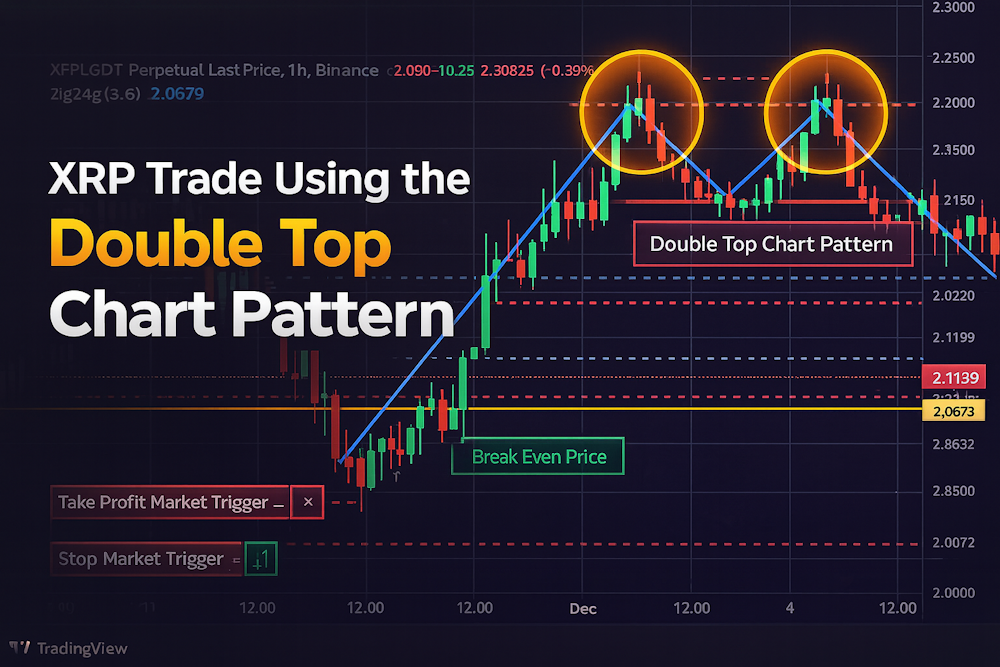
A personal trade journal entry from 4 December 2025: trading XRP around a double top pattern, the decision to close early, and what it taught me about manual trading vs. automation. Educational only — not a recommendation.
However, this trade also highlighted the challenge of manual trading — I had to close early due to real-life obligations. While I captured profit, I missed an extra 10–15% because I couldn’t monitor the charts 24/7.
This post breaks down the trade, the reasoning, lessons learned, and why automation via AlgoColony can help capture these opportunities stress-free.
A note on this post: This is a personal trade journal — a record of one trade I took, why I took it, and what I learned afterward. It’s not a signal, a recommendation, or advice to trade XRP or any other asset. Past trades, including this one, don’t predict future results. If you’re exploring strategies like this, that’s a decision for your own research and risk tolerance.
Key notes
- Identifying a Double Top pattern on XRP
- Entry and exit levels with exact prices and leverage used
- Trade outcome: Profit secured, but missed potential extra gains
- Managing emotions and sticking to a personal risk rule
- Time-commitment challenge of manual trading
- Screenshots showing chart setup & price action
- Takeaways for future trades and AlgoColony strategy automation
The Setup: Spotting the Double Top
I entered short after identifying a classic double top reversal pattern — price pushed up, tested resistance twice, and failed to break higher. When the second top failed, price broke the neckline, confirming the bearish trend.
(Learn more about Double Tops: Corporate Finance Institute)
(Broader explanation: Finance Strategists)
➡️ Entry Price: 2.1781 USDT
➡️ Exit Price: 2.1356 USDT
➡️ Leverage: 5×
➡️ Capital Used: ~30% of account
➡️ Trade Duration: ~8 hours (09:00 → 17:00 UTC+2)
➡️ Take Profit Target: Fibonacci 1.272 extension

This pattern isn’t only for stocks — it applies across crypto, forex and more.
(Broader explanation: Finance Strategists)
The Execution: Why I Took Profit Early
My trade reached my take profit level — great win. But here’s the part every trader knows too well…
The move continued further after I closed.
Had I stayed in, the trade could have been ~20% more profitable.
So why not ride the wave? Because I follow one simple personal rule:
If I open a position manually, I do not leave the screen.
If I can’t monitor it — I exit.
I had obligations coming up and I refuse to stress about an open trade. Profit protected is better than hope-based holding.


🧠 Emotions, Discipline & Time Commitment
Manual trading demands your time, attention, and emotional control.
Yesterday reminded me:
- I made the right decision based on my rule
- FOMO must never replace discipline
- Real life doesn’t stop just because you have a position open
Would more profit have been nice? Sure.
But regret doesn’t pay — profits do.

🤖 Why Automation Wins This Battle
Trades like this highlight exactly the kind of friction AlgoColony is built to remove — not this specific setup, but the underlying problem: manual trading demands constant attention, and life doesn’t pause just because a position is open.
With rule-based automation, in general:
- Strategies can run without someone watching the chart all day
- Predefined rules replace in-the-moment emotional decisions
- Exits follow the plan that was set in advance, not a reaction to stress or distraction
This wasn’t a loss — it was a reminder of the opportunity cost of manual trading, not a blueprint for the next trade.
If you want to explore more about how discipline and patience matter in trading — check out my previous post: [Patience in Trading: The Difference Between Making Money and Building Wealth].
📌 Key Takeaways
- Repeatable setups: Chart patterns like double tops can be expressed as rules in a bot
- Stick to your rules: Consistency beats luck
- Profit is profit: Avoid chasing extra gains out of FOMO
- Manual trading is time-consuming: Automation provides freedom

🏁 Final Thought
This trade reinforced something I already believed: the hardest part of manual trading isn’t spotting the setup, it’s staying disciplined when real life gets in the way. That’s the problem I’m building AlgoColony to solve.
Next time, I’d like the execution to be automated — not so the outcome repeats, but so the stress of manually watching a position doesn’t have to.
More trade journal entries coming soon.
🔗 References & Further Reading
Patience in Trading – AlgoColony
Corporate Finance Institute: Double Top Pattern
Generally yes, in most countries including South Africa, as long as they’re used on regulated exchanges and within local financial laws. Legality can vary by jurisdiction, so it’s worth checking the rules where you live. What matters most is how a bot is used — fraud, market manipulation, or unauthorized trading is illegal everywhere, automated or not.
Beginners can use platforms like AlgoColony, which offers paper trading on live data so strategies can be tested without risking real capital. Backtesting and paper trading are tools for learning how a strategy behaves — they’re not a guarantee of how it will perform with real money.
No. A bot executes rules consistently, but it doesn’t create an edge on its own. Whether a strategy is profitable depends on the strategy itself, market conditions, and risk management — and even well-tested strategies can lose money. Bots are tools for execution, not profit machines.
Chart patterns like double tops are widely discussed in technical analysis as a description of price behavior, but they don’t predict outcomes with certainty. Some traders find structure in combining them with their own risk rules (stop-losses, position sizing); others don’t use them at all. This is a matter of individual approach, not a formula.
(Learn more: Corporate Finance Institute)
Different rule sets behave differently depending on conditions — for example, trend-following logic and range-bound logic respond to the market in different ways. Whether a particular rule set fits current conditions is something each trader has to evaluate for their own situation; it’s not something that can be generalized as “yes, bots adapt.”
A double top is a chart pattern technical analysts use to describe price testing a resistance level twice before reversing. It’s a descriptive label for past price action, not a signal that guarantees a reversal will happen again in similar circumstances.
Disclaimer: This content is for educational and informational purposes only. It is not financial advice. Always do your own research and make investment decisions based on your own circumstances.
A note on this post: This is a personal trade journal — a record of one trade I took, why I took it, and what I learned afterward. It’s not a signal, a recommendation, or advice to trade XRP or any other asset. Past trades, including this one, don’t predict future results. If you’re exploring strategies like this, that’s a decision for your own research and risk tolerance.
Chart pattern cheat sheet
