

Trading bots vs manual trading is one of the first big questions beginners face when entering crypto or FX markets. Should you trade manually by watching charts and making decisions yourself, or automate your strategy using predefined rules that run around the clock?
In this post, you’ll learn:
- The real differences between manual trading and trading bots
- The pros and cons of each approach for beginners
- Why rules-based flow logic matters more than choosing sides
- How AlgoColony helps traders move from manual trading to automation—without going all in on either
What Is Manual Trading?
Manual trading means you analyze the market and execute trades yourself.
How Manual Trading Works
Most beginners start by:
- Watching price charts
- Applying indicators like RSI, MACD, or moving averages
- Deciding entries and exits manually
- Managing trades in real time
Pros of Manual Trading
- Builds foundational market knowledge
- Improves chart-reading and indicator understanding
- Full control over every decision
- Easy to start with small capital
Cons of Manual Trading
- Emotion-driven decisions (fear, greed, hesitation)
- Requires constant screen time
- Inconsistent execution
- Easy to break your own rules under pressure
Manual trading is valuable for learning—but difficult to scale or maintain consistently.
What Are Trading Bots?
Trading bots are systems that monitor the market and execute actions automatically based on predefined rules.
How Trading Bots Work
A trading bot:
- Continuously watches price data
- Evaluates predefined conditions
- Executes actions like placing trades or sending alerts
Example:
If RSI < 30 AND trend is bullish → Buy
If price hits stop-loss → Exit
Learn more about how the RSI indicator works and how traders use it in strategies on Investopedia.
Pros of Trading Bots
- Emotionless execution
- Trades 24/7
- Perfect consistency
- Excellent for repetitive strategies
- Works best when paired with basic manual trading experience and clear rules
Cons of Trading Bots
- Poor logic leads to poor results
- “Black box” bots hide strategy details
- Over-automation without understanding risk
A trading bot doesn’t remove risk—it executes logic exactly as defined.
Trading Bots vs Manual Trading: Beginner Comparison
| Feature | Manual Trading | Trading Bots |
|---|---|---|
| Emotional control | ❌ Hard | ✅ Fully removed |
| Time required | ⏱️ High | ⏱️ Low |
| Consistency | ❌ Varies | ✅ Exact |
| Learning value | ✅ High | ⚠️ Logic-dependent |
| Scalability | ❌ Limited | ✅ Strong |
| Risk control | ❌ Emotional | ✅ Rule-based |
The Real Difference Isn’t Bots vs Humans — It’s Logic vs Emotion
The biggest mistake beginners make is thinking they must choose manual trading or trading bots.
Most successful traders don’t.
They learn the market through manual trading, then use automation to execute proven ideas consistently. The logic stays human—the execution becomes automated. What matters most is whether your strategy is clear, structured, and repeatable.
This is where flow logic becomes essential.
What Is Flow Logic in Trading?
Flow logic means breaking a trading strategy into explicit conditions and actions, arranged in a logical sequence.
Instead of vague ideas like:
“Buy when price looks oversold”
You define exactly what to check and what to do next.
Conditions and Actions Explained (Flow Builder Basics)
In a flow-based trading system, every strategy is built from two core building blocks:
Conditions
Conditions are checks that evaluate the market.
They answer the question: “Is something true right now?”
Examples of conditions:
- RSI is below 30
- Price crosses above a moving average
- Volume increases compared to the previous candle
- A higher high or lower low is formed
If a condition is met, the flow continues.
Actions
Actions are what happen after conditions are met.
They answer the question: “What should the system do next?”
Examples of actions:
- Send an alert
- Place a buy or sell order
- Set or update a stop-loss
- Take profit or close a position
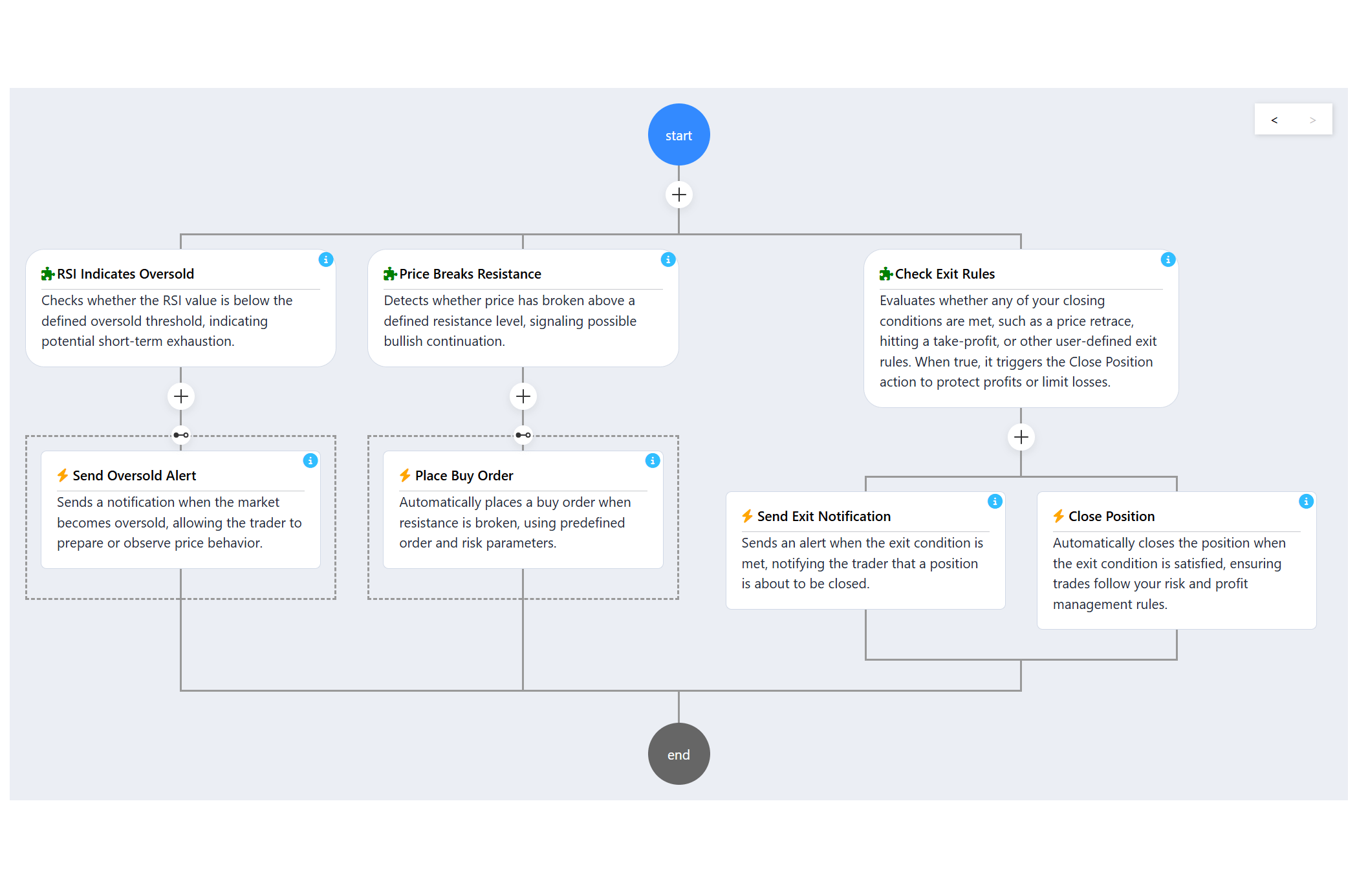
In AlgoColony’s flow builder, strategies are created by connecting conditions to actions in a clear, visual sequence. This keeps trading logic transparent, testable, and easy to improve over time.
See Flow Logic in Action
To help beginners understand how strategies work in AlgoColony, we’ve created two example flows. The first flow demonstrates step-by-step logic, while the second shows parallel conditions with multiple actions, including smart exits.
Use the slider below to explore both flows. Each screenshot highlights how conditions and actions connect visually, showing entry signals, notifications, automated orders, and risk-aware exits.
Understanding proper risk management is essential when setting exit rules. Investopedia has a helpful risk management guide for traders.

Why Flow-Based Trading Is Ideal for Beginners
Flow-based trading forces clarity before automation.
Benefits of Flow Logic
- Removes ambiguity from decisions
- Reduces emotional mistakes
- Makes strategies testable and repeatable
- Allows gradual automation
- No coding required
For beginners, this means you can continue learning through manual trading, while gradually converting successful ideas into structured flows that a bot can execute reliably.
How AlgoColony Bridges Manual Trading and Trading Bots
AlgoColony is built around visual, rules-based flow logic—not black-box automation or “set-and-forget” promises.
With AlgoColony, you can:
- Build strategies step by step using conditions and actions
- Start with alerts before placing real trades
- Run manual trading and automation side by side
- Refine strategies over time instead of going all in
This approach aligns naturally with long-term, low-risk growth, explored further in
Compounding trading works like a long road trip
Should Beginners Start with Trading Bots?
Beginners don’t need to choose between trading bots or manual trading.
A safer approach is to:
- Learn the basics through manual trading
- Identify repeatable setups
- Convert them into flow logic
- Automate execution gradually
This reduces emotional risk while preserving learning.
For a neutral overview of automation benefits and risks, Investopedia’s guide to algorithmic trading provides a solid foundation.
Final Verdict: Trading Bots vs Manual Trading
Manual trading builds understanding.
Trading bots enforce discipline and consistency.
When combined through clear, flow-based logic, beginners can learn, refine, and automate without going all in on either approach. That balance is what creates sustainable trading systems—and it’s exactly what AlgoColony is designed to support.
Are trading bots safe for beginners?
Yes, trading bots can be safer because they follow rules and reduce emotional mistakes. Start small and monitor performance.
Can I learn trading skills while using bots?
Absolutely. You can run bots while practicing manual trades to understand market behavior and strategy outcomes.
Do I need programming knowledge to use AlgoColony bots?
No. AlgoColony uses a visual flow builder with conditions and actions, so beginners can create strategies without coding.
How do I know when to close a position?
You can set exit conditions, such as price retrace, take-profit, or stop-loss. Alerts help you monitor these situations.
Should I only rely on bots for all my trades?
Not necessarily. Bots are tools to assist trading, not a replacement for market understanding. Combine manual trading to build skill and strategy knowledge.
Can I automate multiple strategies at once?
Yes. AlgoColony supports multiple independent flows running in parallel, allowing you to manage multiple entry and exit conditions safely.